Next-generation staffing tool for a global tech leader

new
the brief
Staffing Desk is a B2B platform that connects the right people to the right roles efficiently. It maintains a continuous candidate pipeline by optimizing bench utilization and external hiring. The platform aims to accelerate staffing decisions using data-driven insights.
Problem
The candidate profile was a major bottleneck in the staffing process. 70% of users dropped off the profile because critical candidate data was fragmented across multiple tools, forcing managers to continue evaluation outside the platform.
Solution
I redesigned the candidate profile into a centralized staffing experience, bringing availability, workload, performance, experience, and matching insights into one place. Managers could evaluate candidate fit and take action without leaving the workflow.
Result
Candidate screening became 28% faster, pipeline conversion increased to 14%, and outbound tool usage dropped by 20%, keeping more staffing decisions inside the product.

Before


After: Staffing insights at a glance
Building trust through explainable staffing signals
CONTEXT & CHALLENGE
The next product direction centered on a Kanban-style experience for tracking candidates through the staffing pipeline. Before committing development effort, I created a lightweight concept to test whether tracking was actually the source of the drop-off. Early validation showed that the core issue was different: managers could track candidates, but they lacked the information and confidence needed to evaluate fit.
DISCOVERY & PIVOT
Validating the problem before building the solution
The initial hypothesis
A Kanban-based concept was explored as a way to improve visibility across the staffing pipeline.
The concept invalidation
Early usability testing challenged that direction. Users were. struggling to answer a fundamental question: Is this the right person for the role?
Product pivot
I presented a new direction to Product and shifted the focus from candidate tracking to candidate evaluation: mapped the end-to-end staffing journey, analyzed behavioral data, and conducted 16 interviews across 5 countries.


KEY INSIGHTS
Fragmented candidate data
Low trust in matching
Limited process visibility

Evidence from past interviews

Relevant project history in one place
VALIDATION & ITERATION
Key learnings from users
The Staffing Profile was refined through three rounds of usability testing with staffing teams and hiring managers. Each round focused on real scenarios such as checking availability, comparing skills, reviewing previous experience, identifying blockers, and assigning candidates without leaving the workflow.


By the final round: 85% task success. Users completed the core staffing scenarios successfully.
Nearly 50% faster decisions Managers reached staffing decisions with significantly less effort.
Solution
New staffing profile
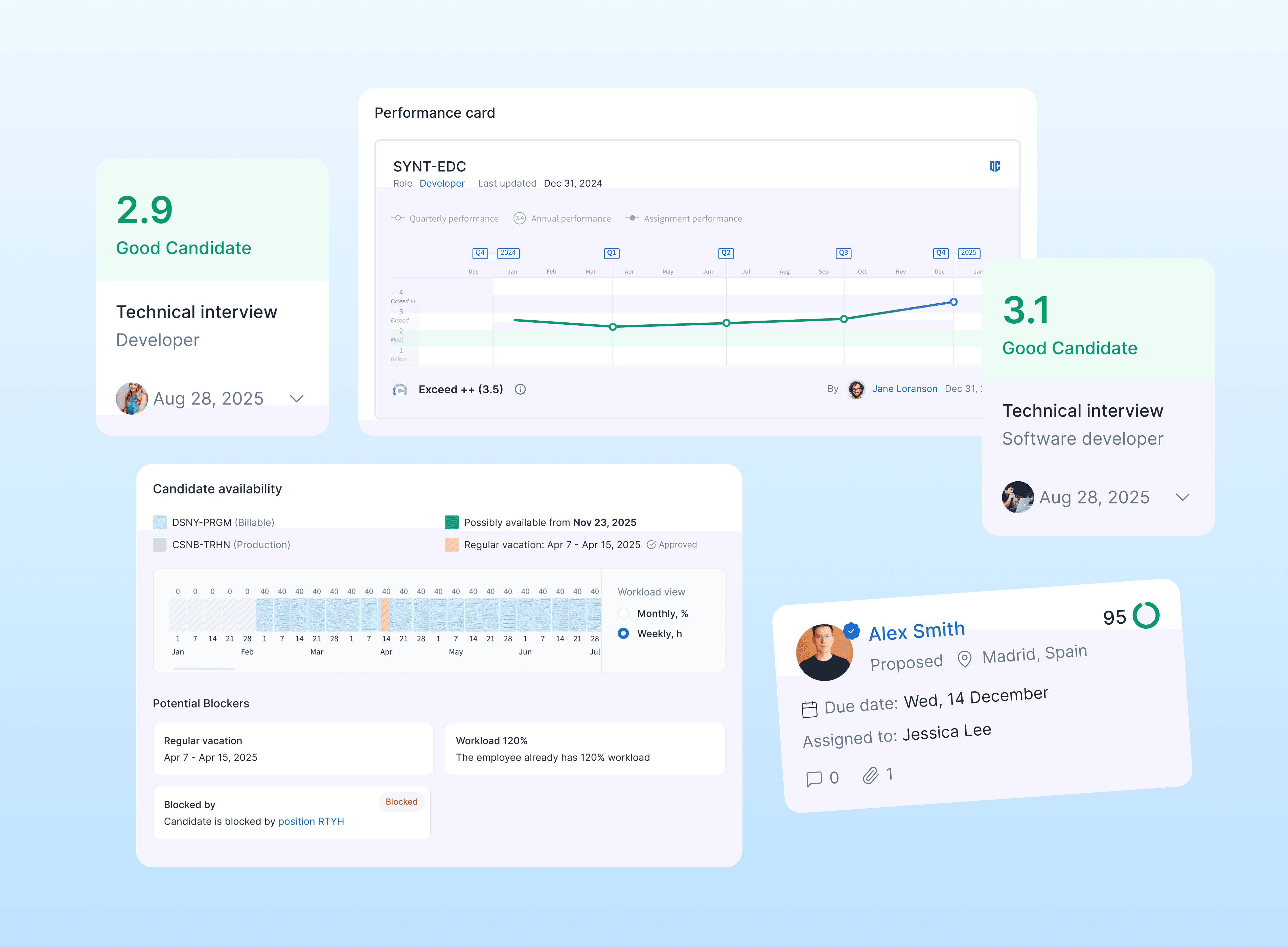
To bridge the trust gap, I designed a centralized Staffing Insights Profile. This solution brought all decision-critical information into one place, accessible directly from the candidate proposal list.
Ranked candidates for faster screening





Making candidate-to-role fit transparent


Performance score widget
PRODUCT TRADE-OFF
Accuracy over speed
For Proposal Limitations, we introduced a deliberate review step before a candidate could be proposed. The additional effort upfront helped managers reduced costly corrections later in the process. As a result, our pipeline conversion improved from 11% to 14%, meaning a higher percentage of proposals led to interviews.

Conflict detection: flagged before proposal, not after
Outcome
More decisions stayed inside Staffing Desk. Three months after launching the redesigned profile and workflow, we achieved significant improvements:
Workload timeline: capacity and blockers, one view
Lessons learned
Validate before committing. Early testing challenged the initial Kanban direction before development. Evidence helped us invest in the problem users actually had, not the solution we assumed they needed.
Use data to challenge assumptions. Behavioral data showed where users dropped off, while interviews and usability testing explained why. Combining both gave me stronger evidence for product decisions.
Trust requires evidence. A match score alone was not enough. Showing the signals behind candidate fit helped managers verify recommendations and make more confident decisions.


